Table of Contents
The Luminous Beauty of Mount Fuji After Sunset
If you’ve ever dreamed of seeing Mount Fuji in its most enchanting form, witnessing it at night is an unforgettable experience. As Japan’s tallest peak, its silhouette against the starry night sky offers a breathtaking view that fascinates travelers and photographers alike. From the shimmering reflection of Lake Kawaguchi to the glowing peaks visible from Yamanashi Prefecture and Shizuoka, the mountain exudes serenity and majesty under the night sky.
Ever seen Fuji breathe at night? Imagine you’re high on the Yoshida Trail or cozy in a mountain hut, far from the daytime scramble. Below, Tokyo and Kawaguchiko sprinkle the darkness like fallen stars – just enough light to make Fuji feel more immense, not less. No crowds, no noise, just you, that silent giant, and a peace so deep you can almost touch it. It’s Fuji’s hidden heartbeat.
Whether you’re a passionate photographer chasing the perfect night view of Fuji or a traveler seeking serenity in a park area like Arakurayama Sengen Park, nighttime transforms Mount Fuji into a luminous masterpiece framed by stars and reflected lakes. This rare side of Fuji ensures that your nighttime encounter with Japan’s iconic mountain is magical.
Best Locations to View Mount Fuji at Night
Lake Kawaguchiko
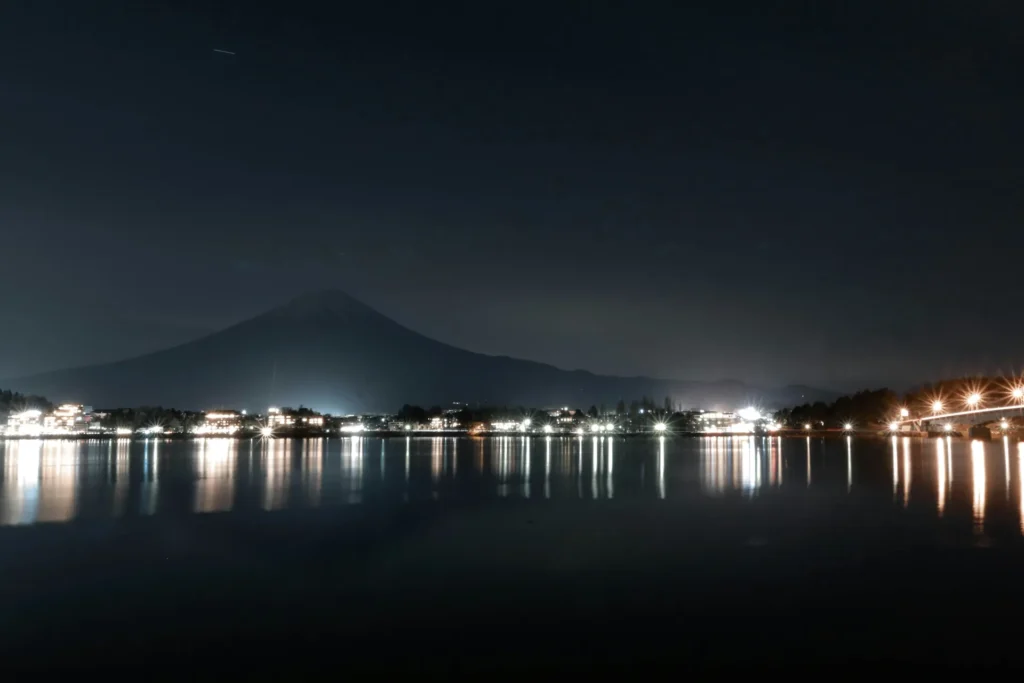
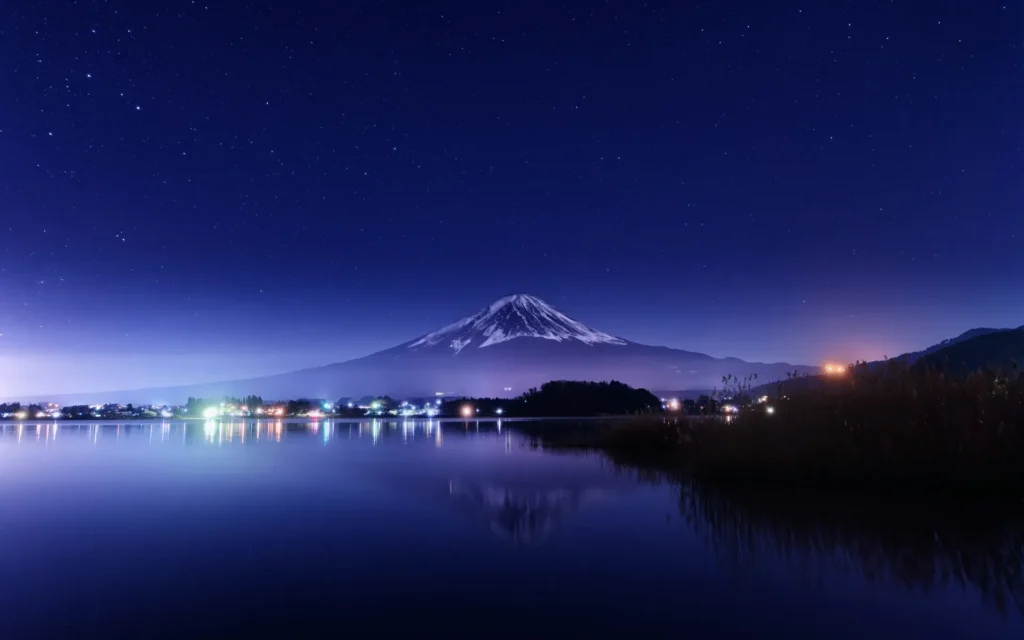
At Lake Kawaguchiko after sunset, Fuji doesn’t just tower above you – it sinks into the water.
Wait for a still night when the lake turns to black glass, and suddenly there are two sacred mountains: one piercing the stars, the other flowing deep beneath your feet.
This mirror-world is why photographers whisper Kawaguchiko’s name, no filter needed – just darkness, water, and a mountain holding its breath.
Around this lake, you can explore popular vantage points such as Oishi Park and the Lake Kawaguchiko North Shore Walking Trail, both of which provide expansive views of the illuminated peak against the starry sky. The area’s relatively low light pollution and high altitude create perfect conditions for stargazing and capturing vivid nighttime photos of Fuji.
The nearby Kawaguchiko town also offers cozy, relaxing spots after soaking in the views.
Arakurayama Sengen Park
For many visitors, Arakurayama Sengen Park is a must-visit location for viewing Mount Fuji at night. Famous for the iconic Chureito Pagoda, this park combines traditional Japanese architecture with panoramic vistas of Fuji. At night, the lit pagoda stands as a striking foreground to the majestic silhouette of the mountain, making it one of the most photographed night scenes in the region.
The park’s elevated position ensures unobstructed views, ideal for those seeking memorable night Mount Fuji images that fuse cultural heritage and natural splendor.
Oshino Hakkai Village
See Fuji draped in moonlight? Visit Oshino Hakkai Village after dark. By day, it’s a postcard-perfect stop near Fuji Five Lakes, but nights here reveal something deeper: traditional thatched roofs and glassy spring ponds reflecting the stars, all cradling the mountain’s silhouette. The daytime crowds fade, leaving only stillness, and Fuji’s presence turns profound. Almost haunting. It’s a side of Japan few pause to witness.
The still waters reflect the peak under the moonlight, allowing visitors to capture tranquil and authentic Mount Fuji night scenes that blend nature, culture, and history. It’s a quieter, less crowded spot for those looking to appreciate Fuji’s nocturnal charm in a more intimate setting.
Tips for Night Photography at Mount Fuji
Equipment Essentials
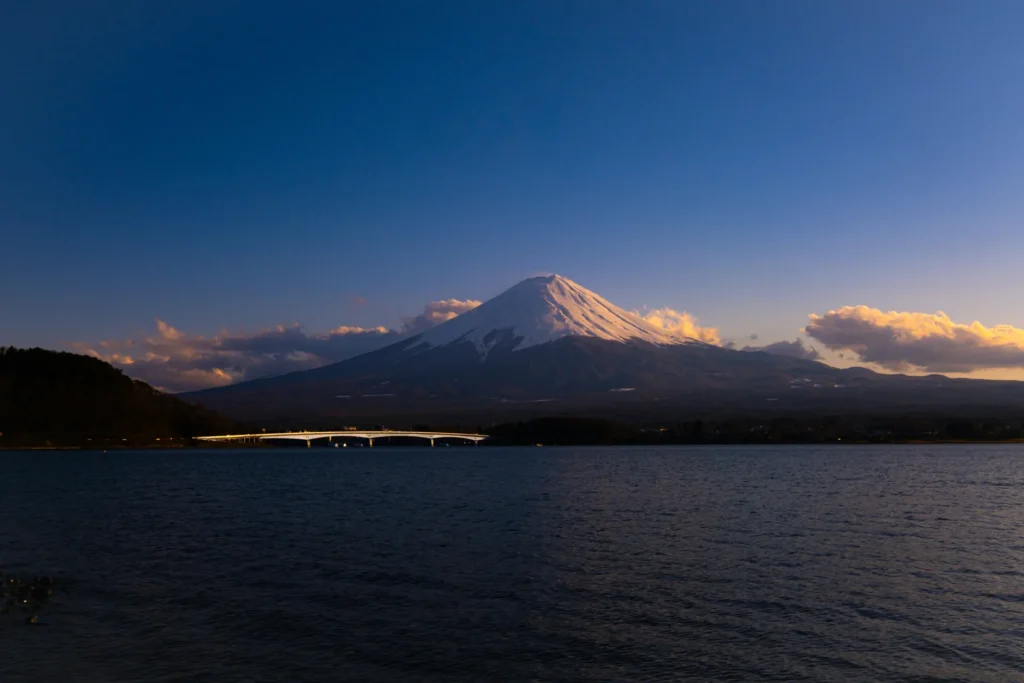
Capturing the beauty of Mount Fuji at night requires the right tools to ensure crisp and vibrant photos. First and important, a sturdy tripod is essential to prevent camera shake during long exposures.
A camera body capable of handling high ISO settings is highly beneficial, as night photography often involves using ISO levels between 3200 and 6400. This helps capture faint light while minimizing noise. For lenses, opt for a wide-angle lens with a fast aperture (f/2.8 or lower) to let in more light—ideal for night scenes and starry skies. Additionally, accessories like a remote shutter release help reduce vibrations, and headlamps are invaluable for safely navigating dark trails.
Remember to shoot in RAW format. It allows you greater flexibility in post-processing and will enable you to fine-tune exposure and white balance with precision.
Photography Techniques
Mastering a few techniques can elevate your images when photographing Mount Fuji at night. Switch to manual focus to ensure the mountain and stars are sharp, as autofocus often struggles in low-light conditions.
Use a long exposure to gather enough light. Depending on your lens and ISO settings, shutter speeds of 15 seconds or more may be required. Keep your exposures under 20 seconds to avoid star trails or use the “500 rule” (divide 500 by your lens focal length) to calculate the maximum exposure time.
Enhance your composition by including elements like the reflection in Lake Kawaguchi or the Chureito Pagoda in Arakurayama Sengen Park. Lastly, patience is key. Allow your eyes time to adjust to the dark and experiment with different settings to capture the perfect nocturnal portrait of Fuji.
Seasonal Variations and What to Expect
Summer Nights
Summer marks Mount Fuji’s official climbing season, typically from July to early September. During this period, the mountain huts along trails such as the Yoshida Trail are open, welcoming numerous Fuji climbers. The evenings in summer are warmer compared to other seasons, making it more comfortable to stay outside and enjoy the starry sky near the summit or from surrounding areas.
However, summer coincides with Japan’s rainy season, meaning clear views of Mount Fuji at night can sometimes be obscured by cloud cover or humidity. Despite this, nights before or after the peak Obon holiday often offer quieter trails and the possibility of stunning, clear Fuji night views. The atmosphere is lively, with climbers reflecting on their day’s ascent, and mountain huts providing cozy spots to rest after sunset.
Winter Nights
Winter is the prime season to witness crisp, clear views of Mount Fuji at night. The dry air and low humidity ensure exceptional visibility from December through February, especially from vantage points like Lake Kawaguchiko or Arakurayama Sengen Park.
Crowned with pristine white snow, the mountain stands dramatically against the dark sky, creating an iconic night view of Fuji. Although temperatures drop significantly after sunset, and layers of warm clothing are essential, the tranquility and breathtaking clarity of the scene make the effort worthwhile. Winter nights also minimize haze and air pollution, which are more common during warmer months, giving you a rare opportunity to see Fuji illuminated by moonlight or softly lit by nearby towns.
Winter provides the best conditions for photographers and visitors seeking to capture Mount Fuji in its purest form at night.
Conclusion: Experiencing the Nocturnal Magic
Experiencing Mount Fuji at night is a truly magical journey that unveils a unique side of Japan’s highest mountain. From the stunning reflections on Lake Kawaguchiko to the iconic views at Arakurayama Sengen Park, the mountain’s nocturnal beauty captivates and inspires. Whether you’re an avid photographer or a traveler seeking tranquility, the proper preparation and seasonal timing can enhance your visit.
Let Fuji steal your breath after dark. Trade crowded trails for constellations, and watch the mountain wear the Milky Way like a crown. This is where photos become feelings – cold air on your face, silence so deep you hear your heartbeat, Fuji holding the night sky.Don’t just see it. Stand inside the moment.
FAQ
What are the best spots to view Mount Fuji at night?
The best nighttime spots for viewing Mount Fuji include the Lake Kawaguchiko North Shore Walking Trail, where the mountain reflects beautifully on the lake’s surface, and Arakurayama Sengen Park, which features the lit-up Chureito Pagoda alongside the cityscape. Other popular spots are the Mount Fuji 5th Station (season permitting) for panoramic views, Nihondaira Yume Terrace for expansive vistas and city lights, and Kawaguchiko Tenjozan Park. These locations combine cultural charm and natural beauty for unforgettable night views.
When is the ideal time to arrive at viewing spots for the best night views of Mount Fuji?
The ideal time to arrive at viewing spots is shortly before sunset, between 6:50 and 7:05 p.m. in July. The timing allows you to witness the transition from daylight to night, offering clear views of Mount Fuji illuminated against the twilight sky.
Are there any special events or festivals near Mount Fuji for visitors to enjoy at night?
Yes, visitors can enjoy special nighttime events near Mount Fuji. In July, the Mt. Fuji – Lake Kawaguchi Mountain Opening Fireworks Festival lights up the night sky with around 2,000 fireworks reflecting on the lake’s surface. In late August, the Yoshida Fire Festival showcases over 100 large torches lit around town, creating a dramatic and vibrant night atmosphere. The Susuki Festival, held the following day, features traditional celebrations that add to the experience.
What are the Best Tips for Nighttime Photos of Mount Fuji?
To capture stunning nighttime images of Mount Fuji, use a sturdy tripod and manual settings to control ISO (up to 3200), shutter speed (slow), and aperture (wide). Slightly underexpose your shots to preserve highlights, and take multiple frames for optimal sharpness. Shooting in RAW with auto white balance provides flexibility for post-editing. Compose your shots with foreground elements of interest for added depth.